- Home
- Paper choices
Best Paper for Coloured Pencils: Tested and Compared
What this covers
Test results from fifteen papers worked with Polychromos, Coloursoft and Pablo, plus a Zest-It solvent check and an erasing check. Top picks, detailed comparisons of the best five, and what each suits: beginners, detail work, layered colour, solvents and toned paper.
If you just want the short answer, these are the surfaces that performed best in my paper-and-pencil tests. Fifteen papers in total, worked with Polychromos, Coloursoft and Pablo, with a light Zest-It solvent check and an erasing test on each.
Top Recommendations at a Glance
The best colour-holding surface on test. Brilliant for rich, punchy colour. Less ideal for very fine detail, and solvents didn't add anything.
Very smooth, excellent edge definition, and superb erasing especially with the oil-based pencils.
Very good results with wax and oil-based pencils. Crisp line edges, very acceptable erasing. The dependable choice if you only want one paper to start with.
Decent results for an inexpensive paper, with the usual caveat that wax pencil erasing smeared more than I'd want for perfection.
Very good performance, and the toned colour can be a real advantage if you like working on warm surfaces rather than a white sheet.
A note on a common "go-to" paper: Fabriano Classico 5 HP (300gsm) has been a long-time standby for wet work, but in these tests it didn't perform as well as some alternatives, and there have been quality-control complaints over the years. For a smooth HP-style surface I'd point most people toward the R.K. Burt Ultra Smooth instead.
The Five Papers in Detail
How each of the top-performing papers behaved with Polychromos, Coloursoft and Pablo, plus a Zest-It solvent check and an erasing check on each. Full method and all fifteen individual results are on the test page.
Clairefontaine Pastelmat (pastel card surface)
- Surface and tooth: fine-grit pastel-style surface, granular feel
- Weight: heavyweight card (gsm varies by product)
- Layering and colour strength: excellent colour holding, strongest on test
- Detail: not ideal for ultra-fine detail due to the granular surface
- Erasing: wax pencil erasing is poor (absorbent surface)
- Solvent: didn't improve results
- Best for: rich colour, heavy layering, bold work
- Price band: Premium
Fabriano Artistico HP watercolour paper (300gsm)
- Surface and tooth: smooth hot pressed, creamy colour
- Weight: 300gsm
- Layering and colour strength: very good with wax and oil-based pencils
- Detail: crisp edges and clean line work
- Erasing: very acceptable, better with oil-based
- Solvent: small difference; best for bedding down early layers
- Best for: an all-round "proper art paper" choice
- Price band: Premium
Daler Rowney Langton Botanical HP watercolour paper (300gsm)
- Surface and tooth: fine surfaced hot pressed, light creamy
- Weight: 300gsm
- Layering and colour strength: strong colour, good surface hold
- Detail: good, though not the sharpest line compared to the smoothest papers
- Erasing: acceptable, smears less with oil-based than wax
- Solvent: worked very well for smoothing colour
- Best for: solvent users, smooth watercolour-paper feel
- Price band: Mid to upper-mid
Legion Stonehenge Kraft (250gsm)
- Surface and tooth: smooth, matt, very little obvious grain
- Weight: 250gsm
- Layering and colour strength: very good colour holding, white shows well on the toned surface
- Detail: good, though the toned paper changes how "crisp" things feel
- Erasing: very acceptable, almost a clean erase
- Solvent: worked well (sample was already quite smooth)
- Best for: toned backgrounds, warm papers, faster "finished" looks
- Price band: Mid
Daler Rowney Heavy Cartridge (220gsm)
- Surface and tooth: relatively smooth cartridge, light cream
- Weight: 220gsm
- Layering and colour strength: decent build for the price
- Detail: fairly defined line edges
- Erasing: wax pencil smearing can be too much if you're picky; oil-based erasing is more acceptable
- Solvent: worked very well for smoothing colour
- Best for: beginners, sketching, practice, budget-friendly pads
- Price band: Budget
For a different angle, see the same drawing on 8 different surfaces: a hands-on paper comparison rather than a side-by-side spec sheet.
Choose Paper by What You're Trying to Do
Not sure where to start?
Here's what I check when matching coloured pencils to paper, from the sound a pencil makes to where the paper will live.
Best paper for beginners (and practice without spending a fortune)
If you're learning coloured pencil, the best paper is one that's forgiving, easy to find, and doesn't feel too precious to use.
- Daler Rowney Heavy Cartridge 220gsm: good overall results for an inexpensive paper. Soft wax pencil erasing can smear more than you'd want for a perfect clean-up.
- Fabriano Accademia 220gsm: a decent student cartridge paper with acceptable overall performance.
Best paper for detailed realism and crisp edges
For botanicals, fur, sharp highlight edges and clean linework, you want a smoother surface that still holds colour well.
- R.K. Burt Botanical Ultra Smooth HP 300gsm: excellent definition and superb erasing, especially with softer wax pencils.
- Fabriano Artistico HP 300gsm: smooth, clean edges, very good all-round performance with wax and oil-based pencils.
Best paper for heavy layering and strong, vibrant colour
If you like building lots of layers and pushing colour saturation, you want a surface with more grab.
- Clairefontaine Pastelmat: the best colour-holding surface on test. Not ideal for the very finest detail because of the granular working surface.
- Hahnemühle Pastelfix cork-surfaced pastel paper 170gsm: not a classic coloured pencil paper, but it performed better than expected and works especially well when you want a background with bite.
Best paper if you use solvents (or like smoothing early layers)
If you use a solvent like Zest-It to smooth pigment, the paper's surface and sizing make a big difference.
- Daler Rowney Langton Botanical HP 300gsm: solvent smoothing worked very well. A long-time personal choice.
- Fabriano Artistico HP 300gsm: the solvent made less difference here (more of an underlayer bed-down), but it's still a very strong surface overall.
Note: Pastelmat didn't benefit from solvent in the test, and on very absorbent surfaces that's not unusual.
Best toned paper option
If you like working on toned paper, so you're drawing the lights and darks rather than filling a whole white page, a reliable toned surface makes life easier.
- Legion Stonehenge Kraft 250gsm: very good performance, and the toned colour can be a real advantage. Erasing was also very acceptable.
Papers I'd be cautious about
Sometimes "popular" doesn't equal "best for coloured pencil".
- Fabriano Classico 5 HP 300gsm: has been a go-to for wet processes, but in these tests it wasn't as good as several alternatives for dry coloured pencil. Past quality-control complaints noted as well.
- Hahnemühle Lana Pastel (Moonstone) 200gsm: the paper colours are appealing, but the test results weren't strong for coloured pencil use.
Paper in Depth
The surface you draw on makes a vast difference to the result. Papers that are too smooth won't pick up enough pigment, so you can't build the colour strength you want. Papers that are too rough pick up plenty of colour but give no accuracy of line or detail. Special surfaces made for pencil work can produce superb results, at a cost.
Weight of the paper
Manufacturers describe papers by weight and surface type. Weight relates to the weight of a square metre of a single sheet, quoted in grammes:
- Copy paper for home printers: around 90gsm. Too light for artwork.
- Cartridge paper: 120gsm or 220gsm. Good for dry media. Heavier paper takes a fair amount of pencil correction.
- Watercolour paper for serious use: 220gsm to 500gsm and above.
The USA and some other parts of the world still use imperial measurements. The common 300gsm watercolour paper compares with 140lb; 400gsm compares with 188lb. I wouldn't recommend any paper under 125gsm (around 60lb) for serious coloured pencil work.
Surface type and colour
Cartridge paper has a fine-grain surface that works very well for graphite and dry media. It also works for pen, which involves very little moisture.
Watercolour papers come in Hot Pressed, Cold Pressed (sometimes called NOT, as in "not hot pressed"), and Rough surfaces. You'll also see labels like Plate, Smooth, Vellum or Satin on various brands.
Pastel papers often have a different surface on each side: one smoother, one with a distinctive lined or honeycomb texture. They come in a wide variety of colours, which makes them attractive to coloured pencil artists, who would normally use the smoother side.
Black paper is also popular, and the blacks differ more than their labels suggest: four black papers tested with the same white pencil. There's also a tutorial showing an indoor scene worked in pastel pencil on black paper, and a dedicated page on working coloured pencil on black paper for tips and techniques.
Presentation
Some drawing papers come in pads with one edge glued or spiral-bound, so they open like a book. Others come in blocks secured along all edges so they're pre-stretched for watercolour use. This last form can confuse a new artist who can't find a way to remove the top sheet. The trick is to inspect the edges of the block: somewhere, often a corner but sometimes along an edge, there's an unsealed area. Carefully separate the top sheet using the edge of a plastic ruler or similar smooth, blunt instrument. Avoid a knife: it can tear the sheet beneath.
How Paper is Made
Paper is a mixture of fibres mixed with water, traditionally made by hand in a mould but now more commonly made by machine. The fibres enter the machine as a slurry, drained of as much water as possible. The resulting wet, felt-like material is pressed between rollers and then dried.
If the finishing rollers are smooth and hot, the paper is smooth: Hot Pressed. If the rollers are cold, the paper is Cold Pressed, or in old artspeak NOT (as in NOT Hot Pressed). Who said artists don't have a sense of humour?
Rough papers are made by pressing the surface between rough woven blankets or rough textured rollers. They're usually heavier weight and more expensive, and less suitable for coloured pencil work, so we won't get excited about them here.
The fibres in drawing paper can be cotton, wood pulp, or a mixture:
- Lower-cost papers often use wood pulp, buffered by chemicals to delay internal acid rot.
- Archival papers intended to last for a long time without yellowing contain cotton.
- More exotic papers, often from the Far East, use ingredients like leaves or bamboo.
Internal and external sizing
Size is a gelatine-like ingredient that lets you use wet media without the paper soaking it up like a sponge. The manufacturer either adds it when the pulp is mixed (internally sized) or sprays it onto the hot paper as it comes off the machine, as a final coat (externally sized).
If you're certain you'll only use dry pencils, you can use unsized paper.
Sometimes a hot-pressed paper like Arches has too much size, and coloured pencils skate over the smooth surface. A neat trick: wipe the paper with a damp cloth to remove some external size and raise the grain, giving the pencils more tooth to grip.
Cartridge paper
Thin papers like cartridge (an unsized paper) work fine for dry coloured pencil, but hold them in place on the drawing board with pins, tape or White Tac so they don't move while you work. Check the board is perfectly smooth first; if not, place a sheet of smooth paper beneath your working sheet to even out any unevenness. I also like to place a second sheet of fresh cartridge paper on top, secured at the top edge by tape or White Tac, to protect my artwork while transporting or storing it before framing.
Stretching Paper for Wet Media
If you add water to an unsized paper, or one lighter than 300gsm (140lb), it's likely to buckle when it dries. But what if that's all you have, and you want to use watercolour pencils with a fair amount of water?
You can pre-stretch the paper to prevent buckling. The page on stretching watercolour paper has the full instructions. If you stretch a sheet and then don't use wet media, the paper isn't harmed.
Drafting Film for Coloured Pencils
A popular drawing surface that isn't paper at all. Drafting film is made from polyester. It looks like a thick tracing paper because it's translucent, very smooth, and takes coloured pencil beautifully, though it reduces the number of layers you can build. The upside: you can work on the back of the film as well as the front, or layer multiple sheets together for more depth.
The weight of the film varies:
- PolyDraw: the flimsiest
- DuraLar: a little thicker
- Grafix Drafting Film: the sturdiest of the three
Another plastic-based substrate worth knowing about is NeverTear "paper". Unlike drafting film, it's pure white and opaque. Another ultra-smooth surface that works well with coloured pencil, and it's waterproof, which means you can take wax pencils out sketching in any weather.
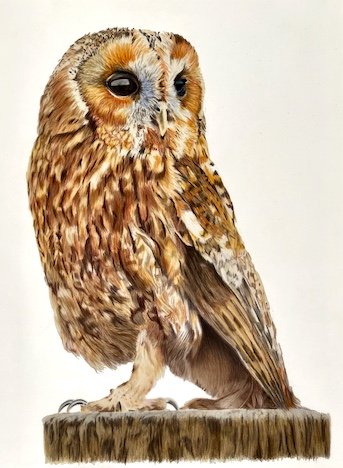
Tawny Owl, worked on a single sheet of Polydraw film (both sides), with cream paper laid behind the drawing for the background
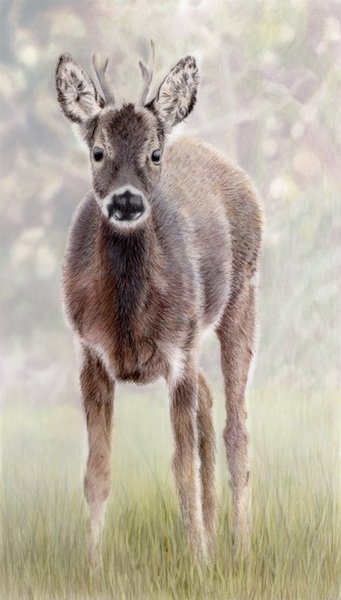
A deer worked across multiple layers of drafting film, showing the depth this technique can build
Sanded Papers
At the other extreme from drafting film's smoothness, you can work on sanded substrates. These have a grit surface that grips hold of pastel or, in our case, coloured pencil.
- UART and Tim Fisher pastel paper: classic sanded surfaces designed for pastel work, but they handle coloured pencil very well.
- Lux Archival: a sanded surface designed and manufactured by Alyona Nickelsen's company Brush and Pencil. It's a white paper rather than the darker colour of UART. Currently only available in the UK from Jackson's Art.
- Clairefontaine Pastelmat: originally designed for pastel artists but excellent for coloured pencil. The surface isn't sanded as such; it has a cellulose-fibre coating that grips the pencil. Allows for many, many layers, but the granular appearance of the first few layers can put some artists off.
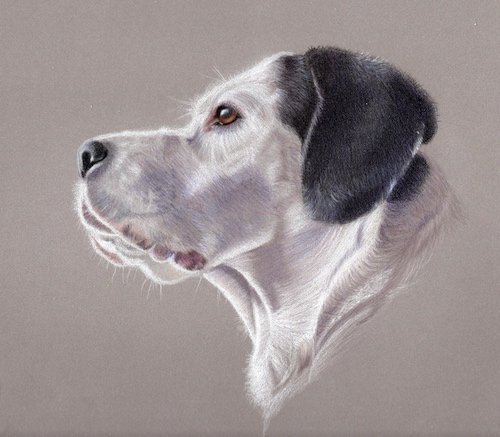
Polly, drawn on Clairefontaine Pastelmat
Copyright © 2009- pencil-topics.co.uk All rights reserved
Home | About Us | Contact Us | Privacy Policy