- Home
- Tutorials
Coloured Pencil Drawing Step-By-Step
What this covers
Twenty-two step-by-step drawing demonstrations from Carol, Peter Weatherill and Daryl Cogavin, grouped by medium: dry coloured pencil, watercolour pencil, pastel pencil and mixed media.
There's a particular kind of drawing tutorial where you don't just see the finished piece. You see every layer, every doubt, every small course-correction along the way. That's what these step-by-steps are. Some are mine, some are Peter Weatherill's, and a few are from Daryl Cogavin, a student who began documenting her own learning process and produced something genuinely useful in the doing.
They're grouped below by medium: dry coloured pencil, watercolour pencil, pastel pencil and mixed media. Within each group, they range from gentle first projects to longer pieces that take real time.
Start here: If you've never worked through a step-by-step before, two friendly first projects. In dry coloured pencil, try the fruit bowl: forgiving shapes, strong colour, a downloadable outline. In pastel pencil, try the simple vase. Neither needs more than a basic starter tin.
Dry Coloured Pencil Tutorials

The Fruit Bowl
A still life of orange, apple and banana, layered up step by step in dry coloured pencil. Covers stroke direction, burnishing, and how to mix a complementary background. Outline sheet provided.
A friendly first step-by-step. Forgiving forms, strong colour.
Open the tutorial
The Sweet Jar
Drawing transparent glass on black paper. We try different pencil brands side by side, so you can see how each one performs on a dark ground. PDF of the reference photo included.
Best after you've practised pressure control on simpler subjects.
Open the tutorial
The Rectory Garden
Peter Weatherill's two-day workshop demonstration: a garden archway in Polychromos on hot pressed paper. Hedge, lawn, brickwork, creeper and flowers, built back to front.
Advanced. Presumes some prior coloured pencil experience.
Open the tutorial
Wild Cat
A realistic cat portrait worked through whiskers, eyes, nose and fur texture, ending with selective darkening to lift the form. Reference photo included for download.
Intermediate. The fur is the long bit.
Open the tutorial
The Bowerman's Nose
A Dartmoor landscape with the Bowerman Stone. Wax pencil and watercolour pencil for the sky and moor; warm greys and dark sepia worked in overlapping circles for the stone's surface. Outline drawing provided.
A good introduction to landscape if rocks and skies appeal.
Open the tutorial
Tavy Rocks
A river scene in South West England with rocks, a large overhanging tree, and lots of varied greens. Includes guidance on adapting the reference photo to make a stronger composition.
Strong in green-mixing. Useful if your greens come out flat.
Open the tutorialWatercolour Pencil Tutorials

Two Pears
Two pears, built up by laying dry colour and then washing it into the paper with a damp brush. The simplest possible introduction to working with watercolour pencils.
Start here if you've never used watercolour pencils before.
Open the tutorial
Grand Union Canal
A traditional narrow boat scene with a stone bridge and water reflections, worked in watercolour pencils first and then dry colour on top. PDF available to download.
Three-part series. Part 1 covers composition planning.
Open the tutorial
Coventry Canal
A rural canal scene through Staffordshire: trees, grasses and water, all in watercolour pencil as the canal winds through the countryside. PDF reference provided.
Open the tutorial
Polperro Harbour
A line and wash exercise in watercolour pencils: trees, buildings and boats in the Cornish harbour at Polperro. A relaxed approach where the line drawing does half the work.
Good if you've come to coloured pencil from sketching or ink work.
Open the tutorial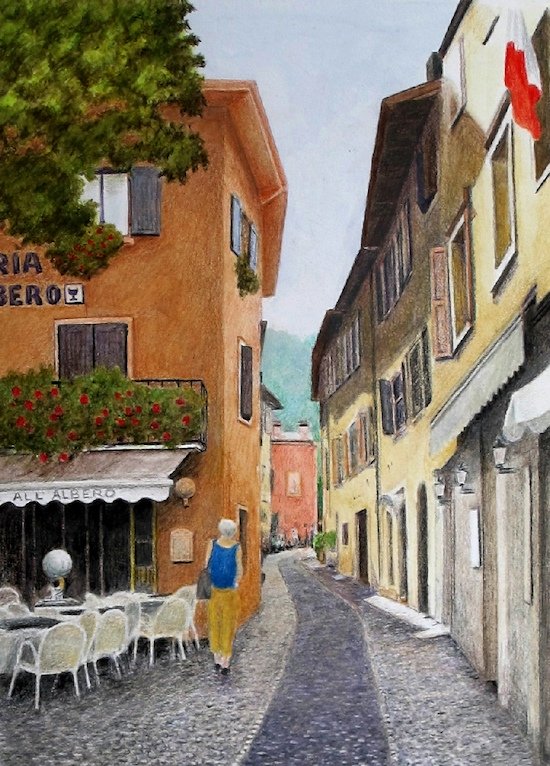
Italian Street Scene
A bright Italian street scene in Caran d'Ache watercolour pencils. Architectural lines, warm shadows, and the splash of colour from shutters and flower boxes.
Open the tutorial
Scottish Hillside
A quick demonstration of soft, atmospheric backgrounds using watercolour pencils. Useful for any landscape where the distant hills need to recede.
A short demo rather than a full project.
Open the tutorial
Brokken Bridge
A Yorkshire Dales landscape with a stone bridge over a stream. Different techniques for grass, trees and foliage, all worked toward natural-looking shapes and shadows.
Open the tutorial
Country Lane
An imaginary country lane built on a watercolour pencil underpainting: pigment scraped from the pencil, dissolved with water, then worked over in dry colour.
The underpainting method belongs in your toolkit.
Open the tutorial
Venice Grand Canal
The Rialto Fish Market on the Grand Canal, completed three times on the same cold pressed paper with different watercolour pencil brands. A seven-page project covering preparation, colour mixing, sky, buildings, water and finishing.
Big project. The pencil-brand comparison alone is worth the visit.
Start the projectPastel Pencil Tutorials

Simple Vase
A simple vase, used to introduce pastel pencils. Layering, blending and shading from the first stroke onward. The lightest possible first project in this medium.
Start here if pastel pencils are new to you.
Open the tutorial
Annecy Reflections
A canal scene in pastel pencil, commissioned by Caran d'Ache. Water reflections worked through soft blending and careful tonal control.
Open the tutorialMixed Media Tutorials

Cottage Entrance
A mixed media exercise on black paper using both pastel pencil and coloured pencil. A useful way to see what each medium does that the other doesn't.
Open the tutorial
Abbey of Bellapais
An abbey ruin built up by combining coloured pencil and pastel pencil. Pastel for the broader tones, coloured pencil for the sharper detail.
Open the tutorial
Allerford
An English village in coloured pencil and watercolour pencil, originally worked as a long online group project over several months. The notes here summarise the discussion. PDF reference and a shorter set of working notes are both available to download.
A substantial project. Best when you have time to sit with it.
Open the tutorialProcess Studies by Daryl Cogavin
Daryl is a student who began documenting her own learning process. Her notes are honest about the wobbles, which makes them genuinely useful to anyone going through the same patches.

Painting Gondolas
A Venice gondola scene worked in mixed media (ink, watercolour and coloured pencil). A look at someone else's working process from start to finish.
See Daryl's process
How to Draw Realistic Water
Daryl's three-part series on coloured pencil water, using a woodland stream as the subject. Materials, first steps, and working through the inevitable rough patches.
Three parts. Honest about the wobbles.
See Daryl's processCopyright © 2009- pencil-topics.co.uk All rights reserved
Home | About Us | Contact Us | Privacy Policy