- Home
- Choosing pencil brands
- Bruynzeel pencils
Are Bruynzeel Design Pencils the Right Choice for Your Realistic Drawing?
In short
Bruynzeel Design are lovely, controlled wax pencils that reward patient layering rather than giving instant colour. If you already enjoy building up tone slowly, the 48-colour wax set handles realistic work beautifully. If you want soft, bold colour straight away, they probably are not for you.
If Bruynzeel Design pencils are already on your shortlist, here is what I found when I actually sat down and put a set through its paces, so you know what you are buying before you spend the money.
Quick Verdict
The short version: these reward patience. They are not the pencil for instant, dramatic colour, but if you like to build depth slowly and stay in control, the results are lovely.
You'll get on with them if you already enjoy layering and have a feel for colour, and you like a calm, methodical way of working.
You'll be happier elsewhere if you are brand new to coloured pencil, you want bold colour with little effort, or you are buying on price alone.
What I'd buy: the 48-colour Bruynzeel Design wax set if realism is your aim. I would skip the aquarelle and pastel versions unless you specifically want those.
What Makes Bruynzeel Design Different (and Why That Matters)
Bruynzeel Design comes in sets of 48 colours, in three types, wax, aquarelle (water-soluble) and pastel, all housed in those distinctive brown wooden barrels with a coloured tip.
The colours overlap across the three types, so the brand is bigger than any one set but smaller than the numbers first suggest. To put it plainly: 34 colours appear in all three types, 14 are unique to the pastel range, and 14 are shared only by the wax and aquarelle. That comes to 63 genuinely different colours across the whole brand.
In practice it means a complete Bruynzeel palette needs more than one set. The good news is that I did not feel short of colours: the 48-colour wax set handled everything I asked of it, even for detailed, realistic work.
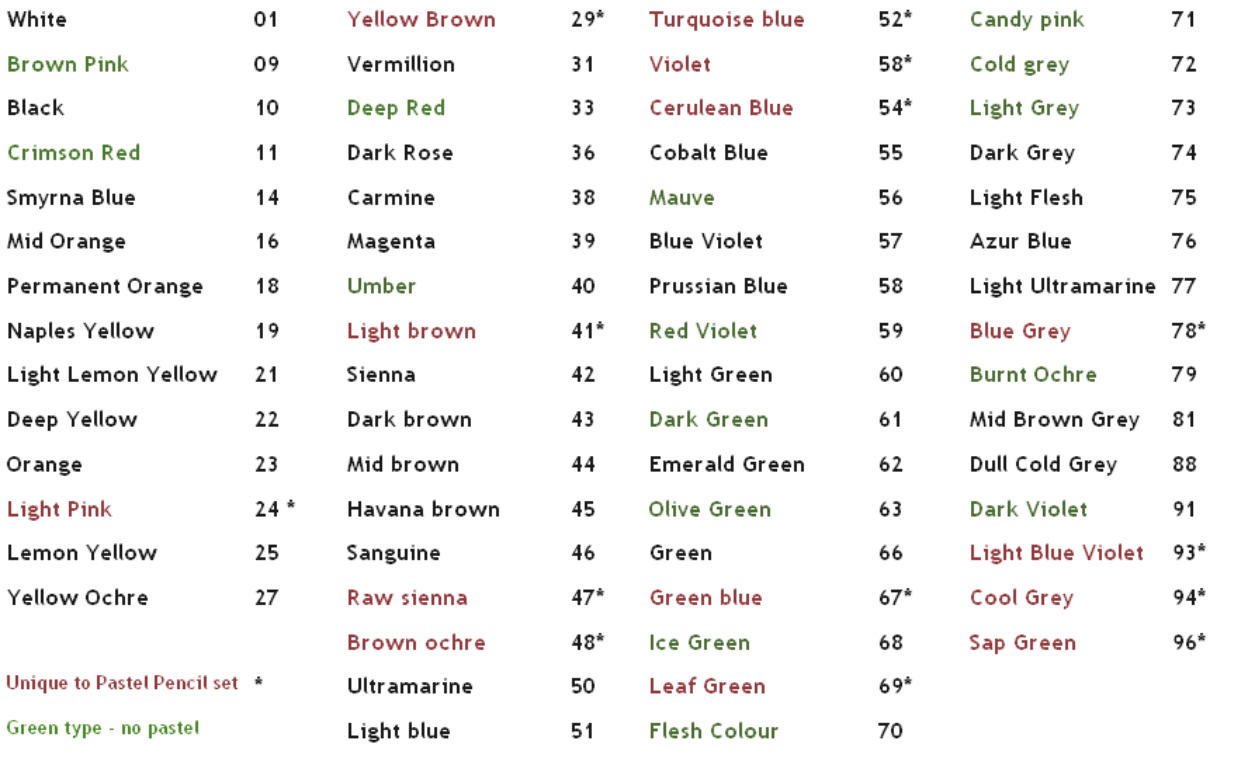
The Bruynzeel Design colour range
How they feel to use
What stands out is how controlled they are. The colour goes down predictably, a little at a time, so you can build depth without the layers turning muddy. If you value accuracy and soft, gradual transitions, that control is exactly what you want.
The box
The drawer-style box is more than a pretty thing. It keeps the set tidy and the colours in order, which matters more than you would think once you own a few brands and the unpainted barrels start to look alike.
My box of Bruynzeel pencils
How They Performed in Testing (Real-World Proof)
Layering
I started with a simple layering test, taking one red wax pencil and building it up from a single layer through to three, six, and ten, to see how the colour develops.
The build was gradual and clean. Rich saturation took longer to arrive than it would with a softer pencil, so you do need a little patience. By around ten layers, though, the colour was genuinely rich and deep. There is an upside to that slowness, especially if you are still learning realism: because the pencils don't dump colour all at once, they are much more forgiving. It is harder to make a sudden, hard-to-fix mistake.
My layering test, building one red from a single layer up to ten
Pressure and mixing
Press harder and the colour does come up to full strength, so they are not only a gentle, many-layers pencil. Mixing stayed clean too: I put a yellow over a blue and got a natural, fresh green rather than a dull one. So you have it both ways, soft and gradual when you want it, or confident and punchy when a passage needs it.
A real drawing: the red apple
To test them properly I drew an apple, which is a lovely subject for seeing how a pencil handles form, reflected colour and shadow.
I started with yellow in the lit areas, leaving the brightest highlight as bare paper. Then I built the body of the apple with a bright red followed by two darker reds for depth. On the shadow side I worked in purple, green and a dark brown, and used a trick I love, sandwiching darker reds between other colours so the shadow has life in it rather than being flat. For the highlights I came back with very pale yellow, peach and a touch of light green, then burnished over the top with white. The stem took yellow, green and brown to feel like real wood.
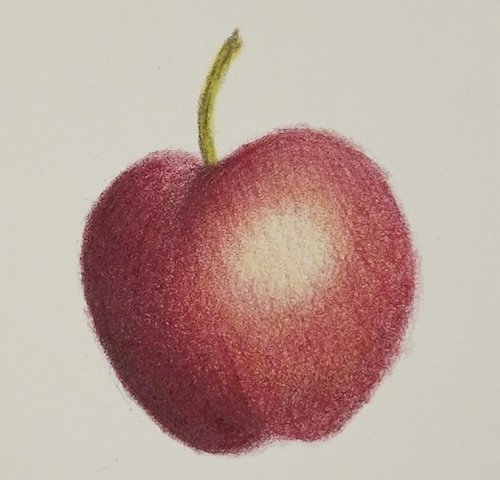
My red apple study, drawn entirely in the 48-colour Bruynzeel Design wax set
It took me about an hour and a half, and I was pleased with it: rich, rounded and convincingly real. Importantly, the 48-colour set had every colour I needed. The apple confirmed what the layering test suggested, that these pencils reward good technique and a bit of colour knowledge with a properly finished result.
Who Should Choose Bruynzeel (and Who Shouldn't)
I think Bruynzeel Design suit you if:
- You already feel comfortable with layering, pressure and colour mixing.
- You enjoy building colour up slowly and staying in control, rather than chasing instant impact.
- You like a calm, unhurried way of working.
- You appreciate a beautifully presented set, and the tidiness that comes with it.
- You can get hold of them, and replacements, from a UK supplier.
I'd point you to something else if:
- You are completely new and want a soft, forgiving pencil that gives bold colour easily.
- You want strong coverage without much layering.
- Budget is the deciding factor.
- You need guaranteed lightfastness for work you'll sell or exhibit.
- You want something you can buy and re-buy easily on the high street.
- You simply prefer a softer, creamier feel.
How They Compare at the Same or Lower Price
A 48-set sits somewhere around £55 to £120, so it is firmly in premium territory. At a similar price you could choose Faber-Castell Polychromos (around £75 for 60), or step up to the fully lightfast Derwent Lightfast (around £90 for 36), which I cover on my Derwent ranges page.
If you want to spend less, Derwent Coloursoft (roughly £40 to £70 for 72, also on the Derwent ranges page) is softer, more forgiving for a beginner, easy to find in the UK and lovely for realistic work. It is not as elegantly boxed, but that won't show up in your drawing.
Buying and Availability (UK, 2026)
Bruynzeel is not on every shelf in the UK, but it is findable if you know where to look:
- Pencils4artists, a reliable source for both sets and single pencils.
- The Coloured Pencil Shop in Ipswich, who carry the full range including open stock.
- A handful of specialist online retailers, where availability is limited but slowly growing.
- The bigger art shops, where stock tends to come and go.
What you'll pay
A 48-pencil wax set runs from about £55 to £120 depending on the supplier. Singles, where you can find them, are around £2 to £3 each. Bought as a set, that works out at roughly £1.70 to £2.50 a pencil.
A practical note
I am one pencil short in my own set, which is a good reminder that organisation matters. The drawer box really does help protect what is a fair investment, and because the bare wooden barrels look much like other premium pencils once they are out on the desk, it pays to keep them in their own home.
The Honest Assessment: A Nuanced Verdict
Put together, the tests told a consistent story. The layering was controlled and predictable, the pressure test showed there is real strength there when you want it, and the finished apple proved the point: these pencils can give you professional-looking realism, as long as your technique is up to it. They reward the artist, rather than doing the work for you.
So, should you buy them?
If you are an experienced artist, or a committed hobbyist with solid fundamentals, the Bruynzeel Design wax pencils are a refined, high-control tool in beautiful packaging, and a genuine pleasure to use.
If you are newer, or watching the budget, start somewhere more forgiving like Derwent Coloursoft or Prismacolor Premier, and come to Bruynzeel later, once you are ready to make the most of that control. And if you do buy in, make the wax set your first stop. Only add the aquarelle or pastel versions if you genuinely want those media.
If you decide to go for it
Buy the 48-colour wax set, check current stock with your preferred UK supplier, and think about adding singles of the colours you reach for most. And do play to the pencils' strengths: they shine when your fundamentals are sound, so my guide to layering and the core techniques hub will help you get the best from them.
Final Thought
Bruynzeel Design pencils are not a magic wand, and they don't pretend to be. But in a steady hand they are a precise, rewarding tool. If you are happy to trade instant colour for control, subtlety and a quietly polished kind of realism, they are well worth the premium.
Where to go next
Still comparing brands? My guide to choosing coloured pencil brands covers the whole field, and the two ranges most worth weighing against Bruynzeel are Faber-Castell Polychromos and Derwent Coloursoft on the Derwent ranges page.
Copyright © 2009- pencil-topics.co.uk All rights reserved
Home | About Us | Contact Us | Privacy Policy