- Home
- Pastel Pencils
- Pastel Paper
- Pastelmat
Pastelmat Pastel Paper Detailed Review
The verdict
Clairefontaine Pastelmat is a surface ideal for soft pastels and pastel pencils, that many coloured pencil artists like myself have also come to love. The potential for multiple layers along with working light colours over dark makes it invaluable.
At first touch Pastelmat seems smooth but if you slowly pass your thumb over it you will sense a very slight fuzziness.
This is due to the unique cellulose fibre coating, which will grab hold of your pencil pigment as you draw on it.
In addition to basic white, Pastelmat gives you the option to pick a coloured background.
You might enjoy working on a medium tone on which your darks and lights stand out.
A dark, like the almost black Anthracite, offers drama, or if you are a little less brave start with the light grey or blue to take the starkness away.
You can buy it in three forms: pads of 12 sheets, full sheets you can cut to size, and mounted boards for extra stability.
For this review, I tested Brown Pastelmat from a pad with Cretacolor pastel pencils and Faber-Castell Polychromos, focusing on layering, blending, and light-over-dark applications.
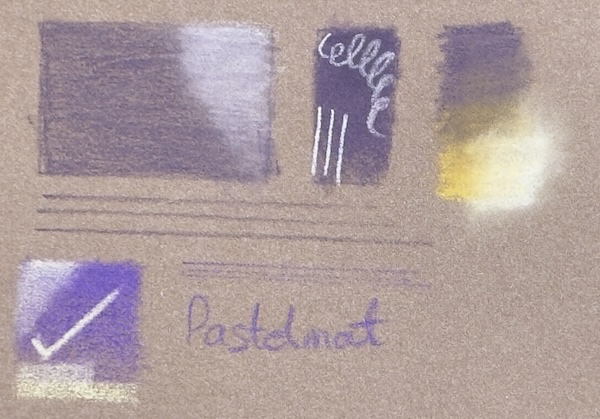
My test swatches on Brown Clairefontaine Pastelmat, demonstrating light-over-dark application, blending, and linework with Cretacolor pastel pencils and Faber-Castell Polychromos.
Performance of Pastel and Coloured Pencils on Pastelmat
Both Cretacolor pastel pencils and Faber-Castell Polychromos glide smoothly on to Pastelmat, laying down even, vibrant colour with minimal dust on initial layers.
Its fine tooth supports extensive layering, often exceeding six layers, allowing deep saturation and complex optical mixing without losing grip.
Light coloured pencils, especially Polychromos, shine brilliantly over darker layers, making Pastelmat ideal for highlights and adjustments. Check the white over purple swatch for proof!
Linework with both mediums is sharp and clean, rivalling the precision of smoother papers while offering better pigment adhesion than sanded papers, which can feel too rough for fine details.
Blending pastel pencils takes some adaptation. Finger blending often lifts pigment, resulting in paler colours, and cotton buds are ineffective.
Instead, layering or gentle use of Sofft tools, which are designed for Pan Pastels, preserves richness.
Coloured pencils, by contrast, blend seamlessly through layering alone, requiring no extra tools, a real advantage for artists like me who love their Polychromos.
Benefits and Ideal Uses
These are the points that make it one of my go-to choices:
- Deep, vibrant results through extensive layering and strong pigment adhesion, reducing the need for fixative.
- Effective light-over-dark application, especially with coloured pencils, for highlights and details.
- Sharp, clean linework for detailed work with both pastel and coloured pencils.
- A versatile, archival surface that’s more refined than laid papers, supporting mixed media like watercolours or acrylics alongside pencils.
- Its strong pigment grip means fixative is optional for coloured pencils, keeping your artworks vibrant for years.
Cons for Pastel Pencils (and Coloured Pencils) on Pastelmat
But as with everything else in life, there are some things to keep in mind before trying Pastelmat:
- Delicate Surface Requires Care: The unique coated surface, while excellent for holding pigment, is prone to scratches from sharp tools, heavy pressure (e.g., ruler edges), or fingernails. Damaged areas are tough to conceal.
- Blending Challenges (Pastel Pencils): Finger blending lifts pigment, requiring layering or Sofft tools for best results.
- Pencil Wear: Pastelmat wears pencils down faster than a flat, smooth paper, and a softer pencil will wear down quicker than a harder one. It isn't as aggressive as some sanded papers, such as Canson Mi-Teintes Touch, so I'd put it somewhere in the middle. Marcia, a reader who draws pet portraits on Pastelmat and rates it her favourite paper, finds it hard on her pencils.
- Removing Colour: Marcia also finds colour harder to remove. For me that's mostly in the early stages, and it gets less difficult as the work progresses. You can also cover darks with lights, which helps make mistakes less obvious.
- Premium Price: Pastelmat’s superior quality and versatility come at a higher cost than traditional laid papers or standard drawing surfaces.
Despite these limitations, Pastelmat remains a top choice for coloured pencil artists, as I’ll explain next.
Suitability for Coloured Pencils on Clairefontaine Pastelmat
Outstanding. Clairefontaine Pastelmat is a top choice for many coloured pencil artists, myself included, because its fine tooth handles wax- and oil-based pencils with ease, maintaining grip even after multiple layers.
Unlike laid papers that don't hold many layers, Pastelmat is smooth yet toothy, allowing deep saturation, seamless blending through layering, and crisp details.
Its ability to make light colours pop over dark underlayers makes all the difference for highlights and refinements.
My Tip and Verdict for Clairefontaine Pastelmat
My tip: I buy Pastelmat by the sheet instead of in a pad, which makes it more economical if you have somewhere to store it.
Clairefontaine Pastelmat lives up to its promise.
For coloured pencil artists, it offers real depth, vibrant colours and the ability to work light over dark.
Although it takes a little care, the archival quality makes it, in my opinion, worth the extra cost for serious artwork.
Whether you’re layering Polychromos for rich saturation on a warm sienna sheet or adding delicate highlights on bright white, Pastelmat encourages your pencils to perform at their best.

Where to Go Next?
If you're interested in comparing Pastelmat to other types of surfaces, you might like to explore these:
Where Pastelmat sits among pastel papers
Traditional sheets, sanded surfaces, velour and Pastelmat, reviewed for coloured pencil work.
Six traditional pastel papers, tested
Hands-on reviews including Canson Mi-Teintes and Fabriano Tiziano.
Sanded papers and other specialist surfaces
Hands-on reviews of UART, Colourfix and other coated and textured options.
Hahnemühle Velour, put to the test
Its soft surface, layering, blending and best uses for pastel pencils.
Is Pastelmat the right paper for you?
The sound, the layers, the cost and where you draw: how to match your coloured pencils to your paper.
Pastels and coloured pencils together
Blending techniques for working in both, including Pan Pastel with wax pencils on Pastelmat.
Copyright © 2009- pencil-topics.co.uk All rights reserved
Home | About Us | Contact Us | Privacy Policy