- Home
- Animals & Birds
Drawing Animals and Birds in Coloured Pencil
What this covers
How to draw animals and birds in coloured pencil, from your own pet to garden birds and wildlife. Full start-to-finish tutorials, plus the handful of principles that carry across every furry or feathered subject you will ever draw.
If you want a subject that keeps pulling you back to the paper, draw an animal. Better still, draw one you love. You already know your own dog or cat's face better than anything else you could choose, which means you will spot the exact moment the drawing starts to look like them. That flash of recognition is half the battle, and it is what makes a pet such a forgiving place to begin.
I have drawn animals and birds for years, from family pets to garden visitors and wildlife, and I will happily admit I talk to them as I go. There is usually a cheery "Good morning, Gertrude!" as I settle down to a portrait. Quirky, perhaps, but it is rather the point of this whole section: animals have character, and coloured pencil is the perfect medium for catching it, layer by patient layer.
Where to start: Begin with an animal you know well, ideally your own pet. Fur or feathers, the thinking is much the same, so pick the subject you care about most. The skills you build on it will carry to everything else you draw.
Start with a full tutorial
The quickest way to learn is to follow a whole drawing from the first light marks to the finished coat. Pick whichever subject is closest to home and work right through it.

How to Draw a Dog in Coloured Pencil
From choosing your photo to handling curly fur, drawn start to finish using Louis, a cockapoo, as the worked example.
Learn to draw a pet from your own photo.
See how Louis was drawn
How to Draw a Cat in Coloured Pencil
A full cat portrait from the eyes and whiskers to glazing the fur, worked from a striking Scottish wildcat.
Learn to draw realistic fur and eyes.
See how the cat was drawn
A Baby Elephant in Reverse
The reverse approach: start at the finished elephant and peel back one layer at a time, down to the first marks on the ear, to see exactly how a realistic drawing comes together.
See how the layers stack up.
See it taken apart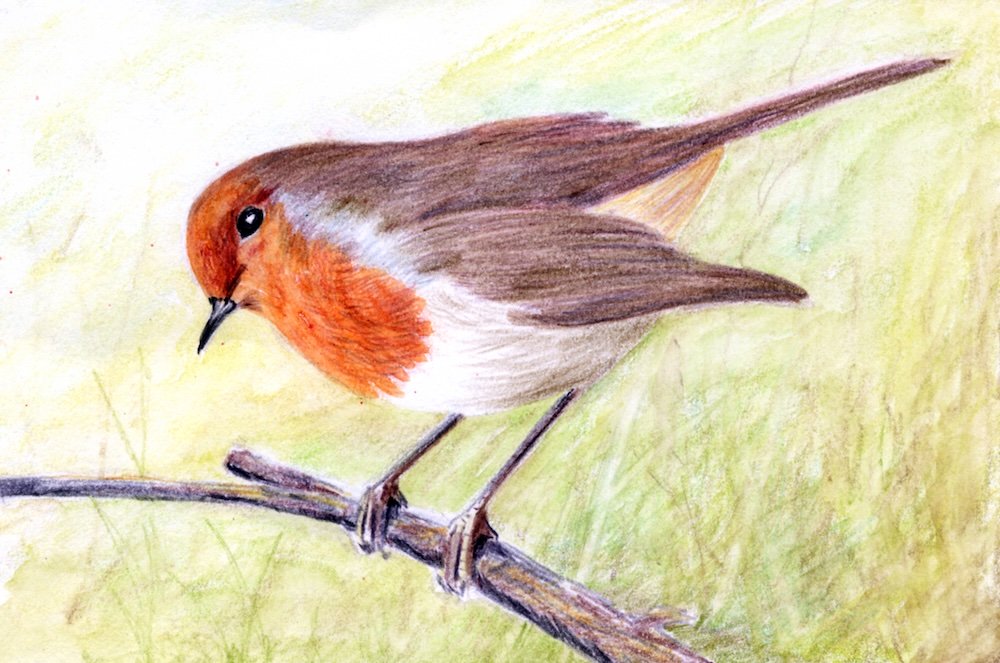
How to Draw a Robin in Watercolour Pencil
A friendly beginner bird with Peter Weatherill: light dry layers softened with a damp brush, then the warm red breast and a soft grassy background.
No drawing skills needed.
See how the robin was paintedWhat every animal drawing comes down to
Whatever the species, the same small set of principles does most of the work. Learn these on one animal and you can draw the next with far less guesswork.
- Start with a sharp photo, eyes in focus. You cannot draw what the camera did not catch, so the reference matters more than anything. Here is how to photograph a pet for a portrait.
- Draw the eyes first. Get the life and expression in early. If the eyes are not right, nothing later will save the drawing.
- Set your darkest dark early. The pupils, and a dark nose or beak, tell you how dark you are allowed to go everywhere else. They fix your range.
- Follow the growth direction. Every stroke lies the way the fur or the feathers actually grow. This, more than detail, is what reads as real.
- Build in layers, and never outline. An outline around a clump of fur or a block of feathers gives a flat, colouring-book look. Let the edges stay soft and broken.
- Pale fur and white feathers are rarely bare paper. Lay a light layer over almost everything, and save the untouched paper only for the very brightest highlights.
Studio tip
When you have finished a drawing you are proud of, protect it. Even good lightfast pencils fade in strong sun, so hang your work out of direct sunlight. More on lightfastness and keeping colours true.
More coming to this section
This part of the site is growing. I am adding tutorials on garden birds, wildlife, and yes, chickens, which make wonderfully characterful subjects. If you would like to hear when a new one lands, the newsletter below is the way to know.
Copyright © 2009- pencil-topics.co.uk All rights reserved
Home | About Us | Contact Us | Privacy Policy