- Home
- Choosing pencil brands
- Conte pencils
Conte Pencils: Pastel, Watercolour and Woodless Reviewed
The verdict
Conté make three kinds of coloured pencil: their well-known pastel pencils, a small watercolour set, and a woodless wax pencil aimed at the education market. The pastels are the ones worth knowing. The woodless wax pencils are hard and stingy with pigment, and I would only reach for them in a pinch.
Conté pencils have been manufactured since 1795, and while their pastel pencils are well known, the watercolour version is seen far less often. Conté are part of the large European ColArt group.
Pastel pencils
The main coloured pencil product from Conté is the pastel pencil, which comes in sets of up to 48.
I cover these in more detail in the pastel pencils section, but in short the Conté pastel pencils are fairly hard to the touch, and come in a slightly oversized barrel that may not fit your mechanical sharpener.
Watercolour pencils
The full set of Conté watercolour pencils has 36 colours and includes a sponge and a small brush. Unusually for a relatively small set, there are three "flesh" colours. I have no firm information on their general lightfastness, but in my experience they seem to perform well. If you come across them at a good price and want a small aquarelle set, they could be useful. They are available on Amazon in sets of 12 or 24, and there is more on water-soluble pencils generally on my watercolour pencils hub.
Wax type conte pencils
For wax-type coloured pencils, Conté make a non-soluble, woodless pencil. The thin core is encased in a resin material that does not splinter. They look quite smart in their glossy black livery, but the pencils carry no colour names or numbers, just "Color Pencil Conté" in silver on the black shaft. That makes it tricky to tell them apart in the tin, so if you try them I would make yourself a colour chart.
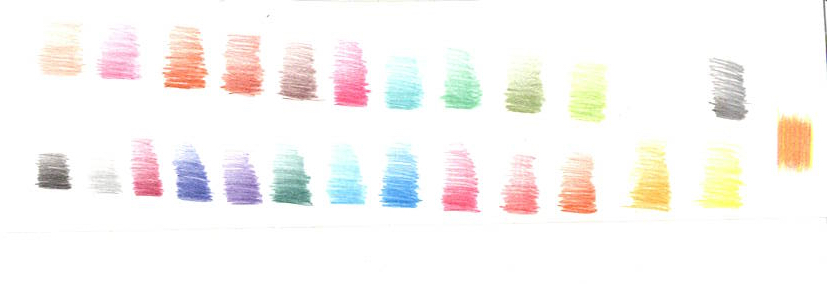
My own chart for the woodless wax Conté pencils, the only way to tell the unlabelled colours apart
They come in sets of 12 and 24, and appear to be aimed at the educational market. I have the 24 set, and find them hard and rather stingy with pigment. They are very transparent, though, which could make them useful for glazing thin colour over other work. Some of the colours are very similar to one another, and there is a mix of bright and muted shades in my tin. They do sharpen to a very fine point and feel quite nice in the hand.
I could not find any information about their lightfastness, but I would not expect a pencil at this price, and not marketed for artists, to be very stable.
On the right of the chart above, I laid white over the black and then tried to blend a yellow and a red together. By the time I had finished this small chart, my hand was aching from the pressure I needed just to get the colour down on the paper.
More recently I put the tin's "Vivid Colour" claim to the test with a simple layering exercise on toned tan mixed media paper: a red circle and a blue circle overlapping, the idea being to build a rich red, a rich blue, and a deep purple where they met.

My layering test in the woodless Conté pencils on toned tan paper. Two layers was all my hands could manage
It did not go to plan. The colour barely deepened after the first layer, and by the second my hand was cramping from the pressure needed to get any pigment down at all. I downed tools, well, pencils, and admitted defeat. Vivid? I would have to disagree.
So I would not recommend these pencils unless you are on holiday, as I was when I bought mine, and cannot find anything else.
Where to go next
Weighing up brands? My guide to choosing coloured pencil brands covers the field, and for Conté's strongest products see the pastel pencils section.
Conte Pencils
Copyright © 2009- pencil-topics.co.uk All rights reserved
Home | About Us | Contact Us | Privacy Policy