- Home
- Choosing pencil brands
- Faber Castell Polychromos
Faber Castell Polychromos and Albrecht Durer
The verdict
Faber-Castell Polychromos is an oil-based coloured pencil with a smooth, layerable core and reliable lightfastness, and one of my long-standing first choices. Its sister range, the water-soluble Albrecht Durer, shares the same 120 colours, so many artists use the two together.
Faber-Castell Polychromos and Albrecht Durer pencils are the two main lines, as far as coloured pencil artists are concerned, made by this family-owned business. The company was established in 1761 near Nuremberg in Germany.
The pencils are manufactured in factories worldwide, and the two lines share a long-established 120-colour range.
There is also an Albrecht Durer Magnus watercolour pencil, with a softer lay-down of colour, higher lightfastness, and permanence once wetted. It comes in 30 colours.
Faber-Castell also make the well-known PITT pastel range, sold both as wood-cased pastel pencils and as solid sticks. There is more on those in the pastel pencils section.
I would rate Faber-Castell Polychromos as one of the three strongest brands among coloured pencil makers, and they have been one of my first choices for several years. I worked the Dartmoor landscape tutorial in Polychromos.
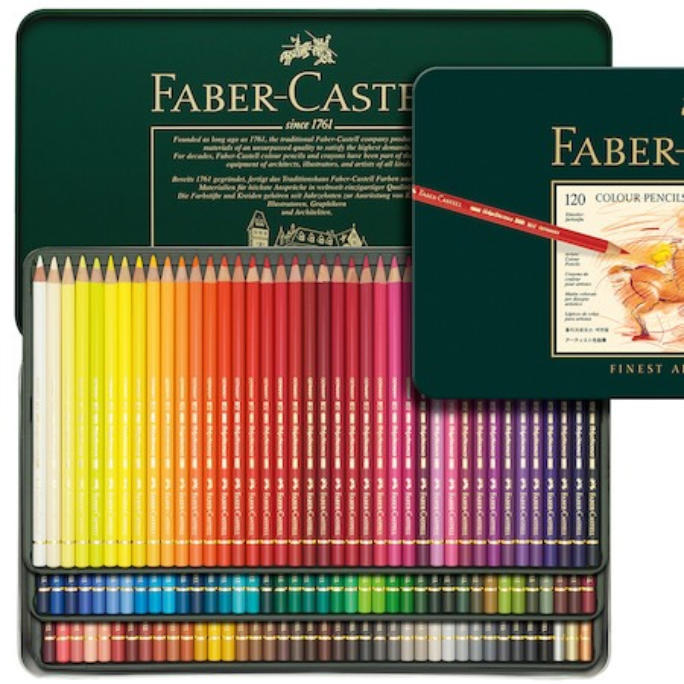
My working tin of Faber-Castell Polychromos, from the 120-colour range
Faber Castell Polychromos
A medium-soft pencil with a very smooth take-up that layers well.
The colour range is very strong on the reds and yellows, and there is only a low level of poorly lightfast colours. A star rating on each pencil shows its lightfastness, from 1 star (which I would treat as poor) to 3 stars (good lightfastness).
Polychromos users tend to be devoted fans. The range favours botanical work, as the flower colours are well represented, and there is a good selection of greys and darks in the set.
Because Polychromos is an oil-based pencil, finished pictures will not suffer from wax bloom, the cloudy haze that can appear over heavily layered wax pencils.
Albrecht Durer
Albrecht Durer watercolour pencils (aquarelles) have a drier feel than Polychromos, as they lack the oil content.
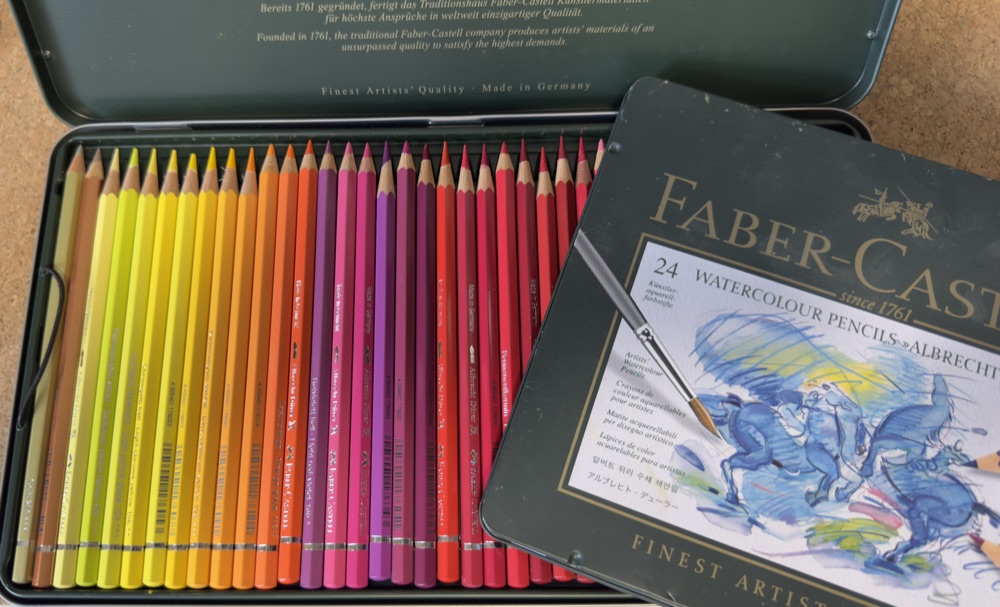
My Albrecht Durer watercolour pencils, the water-soluble sister range that shares Polychromos colours
The aquarelles mimic watercolours quite closely, and the colours behave as you would expect watercolours to. Non-staining earth colours stay non-staining; mixtures that granulate in watercolour often granulate here too. The Albrecht Durer range shares the same 120 colours as Polychromos.
I have used the Albrecht Durer aquarelles to complete an online step-by-step exercise on cold pressed watercolour paper. The results were satisfactory, and I would happily recommend a set for underpaintings, later finished in Polychromos.
Albrecht Durer Magnus
Albrecht Durer Magnus are softer to the touch than the original Albrecht Durer, and noticeably larger in the hand, as they are sold as an underpainting pencil.
They come in 30 high-lightfastness colours. Because you can mix them like traditional watercolour, that is not really a limitation: a basic six, two of each primary, will take you a long way.
In Peter's small trial below, only 5 inches by 2.5 inches, the basic six colours were applied dry to hot pressed botanical watercolour paper, and in some cases burnished, to see how they performed as dry pencils. The aim was then to check for any colour gain or change once wet with a brush. He detected none.
These should prove a useful pencil. They handle well, the colour is good and smooth to apply, and, importantly, they are lightfast. The only drawback is that they are a little large in the hand for fine, detailed work.
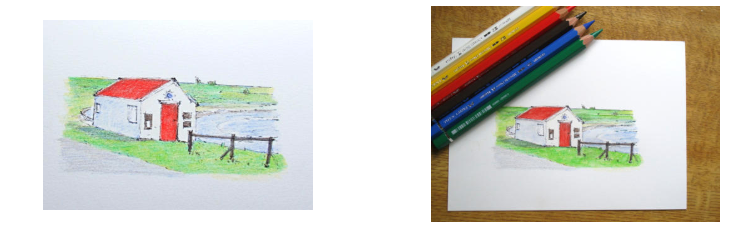
Albrecht Durer Magnus: dry on the left, and after water was added on the right
Availability and further information
Distribution of Faber-Castell Polychromos and Albrecht Durer in the UK is wide and efficient. Larger retailers and mail-order outlets stock single colours as well as sets.
A reliable supplier of both sets and single pencils is pencils4artists.co.uk, based in Dartmouth in Devon. Another good source is Studio Arts of Lancaster, one of the few independent art-materials retailers left in the UK, who stock the whole Faber-Castell range as boxes and single pencils and sell online.
For more background, the Faber-Castell website carries colour charts and lightfastness data.
As mentioned above, Faber-Castell use a star system to show the light stability of each pencil, with 1 star the lowest. Faber-Castell rate 1 star as "good", but I would suggest avoiding the 1-star colours and working mainly with the 2 and 3-star ones where you can. If lightfastness is new to you, my guide to the lightfastness test explains how to check your own pencils.
To summarise
A well-established range of 120 colours, easy to find both as sets and as single replacement pencils. They handle well and the results are predictable. For me, Polychromos has earned its place as a long-term first choice.
Where to go next
Comparing brands? My guide to choosing coloured pencil brands covers the full field. The two ranges I would weigh Polychromos against are Caran d'Ache and Derwent.
Copyright © 2009- pencil-topics.co.uk All rights reserved
Home | About Us | Contact Us | Privacy Policy